Buying a home – Is it a good investment?

Update 12-28-2014: According to this WJ article, less than 4% annual pre-inflation appreciation and selling costs don’t make it an attractive one although you do eventually own the asset or have “some” equity.

God only knows how sometimes frustrating and often strenuous home mortgage/home hunting/purchasing is on your system – but hey, it’s a major purchase and you should take some time to evaluate as many aspects of a home purchase as you can including asking yourself – is it all worth it? Here’s some info on the stress levels and reducing it.

After reading the CBS article about a home being a poor investment, one has to wonder.

Sure there are mortgage interest payments, some of which but not all, you “may” be able to take as itemized deductions from your income taxes – but I’ve seen information that >60% that have mortgages don’t pay enough or have enough interest payments to have any extra deductions.

Yes and you are paying yourself back of the principal amount you borrowed a little each time you make a mortgage payment and pay yourself back a little, but how much of that savings goes toward painting; decorating; furnishings; repairing or replacing roof, HVAC, water heater, plumbing, electrical, windows, doors, appliances, etc.; landscaping; and other expenses before you decide to move a few years down the road and try to ell the house for at least more than your loan balance so you don’t need to cough up any money at closing?

Posted in Uncategorized | Comments Off on Buying a home – Is it a good investment?

Winterize your pipes and sprinklers

Apparently, only the top 2-3 inches of ground in Georgia ever freeze, so most plumbing below that level are pretty safe from freezing.

However, those faucets, valves (back flow prevention), and pipes exposed to the freezing weather are subject to damage.

Cover those exposed pipes or valves with foam, burlap bag, or other insulation material (some products are sold at home improvement stores).

Drain your sprinkler system – disconnect, drain, and store in a moderate temperature environment.

Know where your main water supply cut-off is located.

Also, keep mulch 12-18 inches from foundation of house to prevent creating warm, moist environment for insects and pests.

Source: MDJ. 12-8-2013, 2E

Posted in Uncategorized | Comments Off on Winterize your pipes and sprinklers

In-house lenders at Builders/Real Estate Brokerages

Update 1-27-2015: For Loan Originators: How To Compete Against A Builder’s Lender

In accordance with the 2010 Wall Street Reform and Consumer Protection (Dodd-Frank) Act, the CFPB has recently ruled that builders and real estate brokers must also comply with the 3% cap on lender related costs.

This is a controversial subject or many reasons.

(1) Some closing costs are covered: Builders often offer payment of some closing costs “only” if you use their approved lenders. This stifles your choice of lenders but builders have greater assurance that the property sale will close.

(2) Competition: Is this still a good deal for the consumer if they can’t shop around to qualify and compare or the rates or fees are higher? The CFPB rule should control rates and fees, but builders may still offer other incentives for appliances/upgrades if you use their lenders?

(3) “Appearance of stacked against Buyer”: How does the Buyer know if they could have a better deal?

(4) Monopoly?: This has the appearance to eliminate competition and service.

Other points: About 60% of the new home sales closed for DR Horton using their preferred lenders.

Source: WSJ, 1-11-2013, B3

Posted in Uncategorized | Comments Off on In-house lenders at Builders/Real Estate Brokerages

Senator Tom Coburn’s 2013 Wastebook

Will you be asking your US Representative or US Senators for their suport in eliminating any of these expenditures?

Ton Coburn’s 2013 Government Wasteful Spending revealed.

Tom Coburn’s 2013 Wastebook here.

Here are just the first 10 wasteful spending projects:

1. Paid to Do Nothing – (Government wide) At least $400 million

2. It’s a Bird. It’s a Plane. It’s Superman! – (National Guard) $10 million

3. Uncle Sam Looking for Romance on the Web – (NEH) $914,000

4. Obama Administration Studies American’s Attitudes Towards Filibuster as Senate Majority Leader Eliminates the Longstanding Senate Right to Debate – (MO) $251,525

5. Beachfront Boondoggle: Taxpayer’s on the Hook for Paradise Island Homes – (HI) $500 million

6. Pimping the Tax Code – (NV) $17.5 million

7. Mass Destruction of Weapons – (DoD) $7 billion

8. Let Me Google That for You: National Technical Information Service – (Department of Commerce) $50 million

9.Millions Spent Building, Promoting an Insurance Plan Few Want and a Website that
Doesn’t Work – (Department of Health and Human Services) At least $379 million

10. Cost of Unused Mega – Blimp Goes Up, Up and Away – (Army) $297 Million

Other examples:

Examples of wasteful spending highlighted in “Wastebook 2013” include:

  • Uncle Sam Looking for Romance on the Web – (NEH) $914,000

    The Popular Romance Project has received nearly $1 million from the National Endowment of the Humanities (NEH) since 2010 to “explore the fascinating, often contradictory origins and influences of popular romance as told in novels, films, comics, advice books, songs, and internet fan fiction, taking a global perspective—while looking back across time as far as the ancient Greeks.”

  • Mass Destruction of Weapons – (Department of Defense) $7 billion

    As the U.S. war effort in the Middle East winds to a close, the military has destroyed more than 170 million pounds worth of useable vehicles and other military equipment. The military has decided that it will simply destroy more than $7 billion worth of equipment rather than sell it or ship it back home.

  • Millions Spent Building, Promoting an Insurance Plan Few Want and a Website that Doesn’t Work – (Department of Health and Human Services) At least $379 million

    With nearly half-a-billion dollars in government funding put behind promoting a product that relatively few people seem interested in purchasing off a website that doesn’t work, Obamacare is perhaps the biggest marketing flop since Coca-Cola introduced the world to “New Coke” in 1985.

  • Government Study Finds Out Wives Should Calm Down (NIH) $325,525

    If your wife is angry at you and you don’t want her to stay that way, you might avoid passing along the findings of this government study. Wives would find marriage more satisfying if they could calm down faster during arguments with their husbands, according to government-funded research.

  • Fort Hood Shooter Continued to Collect Government Paycheck (Army) ($52,952 in 2013)

    While the families of the survivors and victims were fighting to receive military benefits, the Fort Hood shooter Major Nadal Hasan was cashing his paycheck. Since the shooting, Hasan has received over $278,000 in military benefits because the Military Code of Justice doesn’t allow a soldier to be suspended until they are found guilty.

  • NASA Searches for Signs of Intelligent Life … in Congress – (NASA) $3 million

    One of NASA’s next research missions won’t be exploring an alien planet or distant galaxy. Instead, the space agency is spending $3 million to go to Washington, D.C. and study one of the greatest mysteries in the universe—how Congress works.

  • Hurricane Sandy “Emergency” Funds Spent on TV Ads ($65 million)

    In January 2013, Congress passed a bill to provide $60.4 billion for the areas devastated by Hurricane Sandy. However, instead of rushing aid to the people who need it most, state-level officials in New York and New Jersey spent the money on tourism-related TV advertisements.

  • Federally Funded Solar Panels Covered at Manchester-Boston Airport Because the Glare Blinds Pilots and Controllers (FAA) – $3.5 million

    When officials at the Manchester-Boston Regional Airport in New Hampshire installed new solar panels, they did not anticipate one quarter of them would not be used 18 months later. In Spring 2012, the panels were placed on top of the airport’s parking garage, and 25 percent have remained there, covered with a tarp, rendering them useless. Problems with the new panels were noticed almost immediately by air traffic controllers who claimed that for 45 minutes each day, glare made it difficult to oversee the airport’s runways.

  • Need Brains! Fighting Zombies with Pluses and Minuses — (NC) $150,000

    A grant from NSF went to a company in North Carolina to develop a math learning game based on the zombie apocalypse.

  • NASA’s Little Green Man (NASA) — $390,000

    Since NASA is no longer conducting space flights, they have plenty of time and money to fund a YouTube TV show and cartoon series called “Green Ninja” in which a man dressed in a Green Ninja costume teaches children about global warming.\

  • Posted in Uncategorized | Comments Off on Senator Tom Coburn’s 2013 Wastebook

    California Lead Based Paint Clean-up Fund

    Update 1-27-2015: EPA settles with Student Works Painting, Inc., for failure to comply with lead-based paint regulations at a home in Boise, ID

    A California Judge order three paint manufacturers (Sherwin-Williams, NL Industries, and ConAgra Grocery Products) to to share in paying $1.1 Billion into a fund to be administered by the California Childhood Lead poisoning Prevention Branch.

    But the decision is being appealed by the defendants challenging the information available decade ago vs what we know today, long after lead was removed from paint.

    Note: I’ve been told by some older painters from the 50’s and 60s that they used to add lead in paint because lead made the paint stick to wall/frame better, even though the manufacturers made “lead free” paint.

    I’ve got to believe California couldn’t afford to make repairs to state run facilities so the participants tried to hake down current paint manufacturers to pay for distantly past sins no matter if they participated or not.

    See my earlier blog post on Lead Based Paint Remodelers

    Source: WSJ, 12-17-2013, B1

    Posted in Uncategorized | Comments Off on California Lead Based Paint Clean-up Fund

    Conventional mortgages to cost more in 2014

    For those borrowers using conventional mortgages who don’t have at least 20% down payment “and” at least a 760 FICO credit score, they will be expected to pay a minimum of 2% of the loan amount in fees. In some cases, credit scores are too low, more than 2% in fees will be charged.

    These fees are passed onto the borrower in the form of higher interest rates. The higher fees, designed to make Fannie and Freddie less vulnerable to losses, are expected to raise interest rates about 0.4 of a percentage point on the average.

    Source: WSJ, 12-18-2013, A3.

    Posted in Uncategorized | Comments Off on Conventional mortgages to cost more in 2014

    Water heaters and expansion tanks – planned obsolescence?

    About 3 years ago, I had my water heater replaced (after the first tank was 15 years old and the second one lasted about 7 years) and had a new water pressure expansion tank installed.

    Last month I wandered past the water heater and noticed a small amount of water on top of the water heater. I noticed the expansion tank was a little rusted out near the connection and a slow drip of water coming out….after only about 3 years! When I asked 3 different plumbing contractors to quote on a replacement, each told me those tanks don’t seem to last more than 3 years….Why not?

    With water heaters lasting only 6-7 years now and expansion tanks lasting < 3 years, some plumbers may not want the risk of just installing a new expansion tank on an older water heater without replacing both devices at the same time. But even if they will install it, it's now going to be at least a recurring homeowner expense anywhere from $220-300 every few years. Maybe this will create an incentive to install a tankless water heater, but that still costs thousands in plumbing (supply line and exhaust) and installation costs...but so will the constant change of water heaters and expansion tanks. Is this another conspiracy (making systems that last shorter periods) against homeowners? Should we storm the water heater and expansion tank manufacturers to let them know they should make them last longer? Only time will tell and enough angry consumers but for now it is just another back door charge to homeowners and homeownership expense to consider. As a side note, our county (Cobb) water system is installing back flow preventer water valves (to prevent water backing up into water system that may be contaminated from homes) on the water supply lines to our homes. Residents are advised to have the water expansion tanks installed on their water heaters to prevent problems with the additional pressure if a back flow were to occur.

    Posted in Uncategorized | Comments Off on Water heaters and expansion tanks – planned obsolescence?

    What’s in store for real estate in 2014?

    My college professors used to say “It all depends”…

    2-3-2014: National Association of Realtors reported about 60% of annual home sales occur during the Feb-June spring selling season…National Association of Home Builders estimated nearly 600,000 new homes will be sold in 2014 (40% increase from 2013)….housing analysts/economists say job growth is more important indicator than interest rate and other factors. Source: WSJ, 1-29-2014, C10.

    1-28-2014: Fewer first time home buyers – many reasons including low credit scores, unemployment, and student debt. Source: New Low for First-Time Home Buyers

    Update 1-25-2014: The Wall Street Journal (Home Sales Expected to Cool After Big Year – 1-24-2014, Page A2) reported home sales will be rather flat through rising interest rate’s downward pressure on prices and lack of good inventory is putting upward pressure on prices – causing a sort of price stabilization at higher rates make it less attractive to purchase a home.

    …more than likely, actions taken by the Federal Reserve and its impact on mortgage interest rates for one thing.

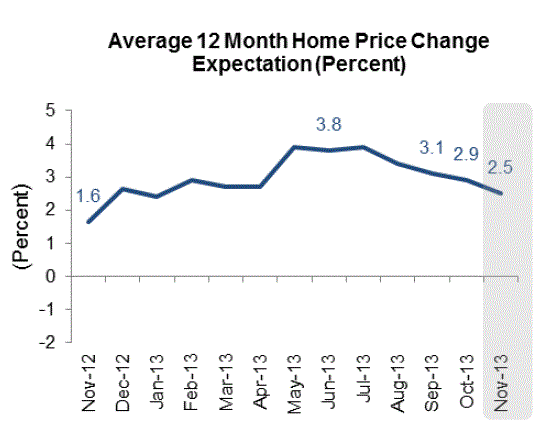
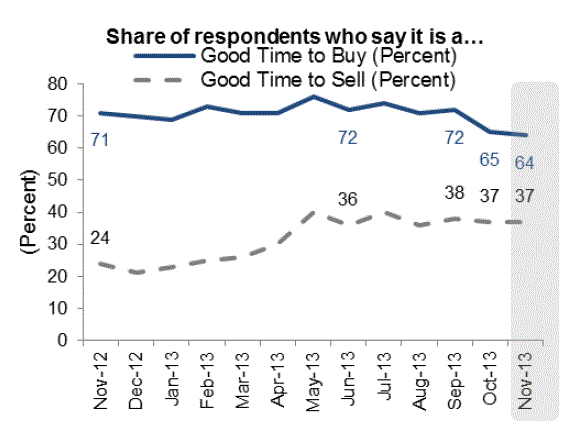
    Certainly, it is good news that mortgage foreclosures are at a 6 year low according to news media reporting. But based on consumer confidence reflected in Fannie Mae Survey of Consumer Confidence of US Economy, alot depends on where the economy goes.
    Source:http://www.mortgagenewsdaily.com/12092013_national_housing_survey.asp

    Summary: Interest rates were in the low to mid 3’s before June of 2013 and things seemed sailing along. Home prices were rising, home sales were humming, and foreclosures were being acquired by the thousands to clear up distressed inventories. Home sellers started realizing prices were rising and started to put their homes on the market to capture the higher prices. Then in May/June time frame, Ben Bernake mentioned the Federal Reserve may consider withdrawing the 85 Billion per month purchase of Treasuries and Mortgage backed securities..and all of a sudden, the housing rebound hit the brick wall…interest rates rose quickly, have been hovering around the 4% mark in December of 2013, and haven’t returned to the low to mid 3’s since.

    With the sudden rise in rates came a sudden downturn in home purchases.

    And there lies the outlook for 2014:  Rising interest rates, falling demand, and fewer foreclosures and fluctuating inventory levels…in other words…it all depends…on how strong the economy grows.  With rising consumer confidence, you’ll see improving housing economy.  If stagnant or declining consumer confidence, then the real estate market will plug along. Here is survey results in 2013 of confidence it’s the right time to buy or sell a home.

    One prediction: interest rates and home prices will rise: http://www.propertywire.com/news/north-america/us-home-value-outlook-201312108550.html

    And since nobody has a crystal ball, even the experts see an up and down year in 2014 with rapid rises and declines in micro markets (i.e., subdivisions or local communities).

    Dodd-Frank law, creating the CFPB, is still a joke to resolve any problems that created the real estate crisis. One good thing may be their combination of the Truth In Lending & Closing Settlement statement into an “easier to understand” format, but the majority of borrowers didn’t need the simplified forms. The CFPB also defined the Qualified Residential Mortgage (absent of a down payment requirement). The FHA is going to both increase and require annual MIP for all FHA loans in 2013 and beyond to become “permanent”. That means the annual MIP is never eliminated after the original LTV reaches 78% (per current Federal law).

    So how does all this impact you?

    Update 4-12-2013: What’s happening in 2013? Some ups and some downs…http://www.forbes.com/sites/morganbrennan/2013/04/12/where-u-s-real-estate-might-be-getting-bubbly/

    Parker’s Projections for 2014

    – You will continue to hear that the housing prices are rising back up – Well, that all depends on where you look and since all real estate is local – it depends on prices and condition in your subdivision/immediate area. In my subdivision, similar homes but different physical conditions have sold for as low as $59K to as high as $189K. If you need me to run an analysis of your home’s range of prices, let me know but it will depend on prices in your subdivision and within a mile radius.

    – There are still millions of homeowners underwater (owing more than their house is worth) and it will take a while to reverse that direction even after the 1 million homeowners helped through HARP and HAMP efforts. The current economy seems to stumble along, but if the economy gets worse next year, expect foreclosures to start rising. Especially since the major class action Federal lawsuit against lenders for non Government loans was settled for $25 billion (and the total estimated public and private lawsuit settlements are about $110 Billion when the dust settles) and impact of Obamacare will be clearer on the full time employees and business decisions to continue employment/operations.

    – The Federal Reserve has committed to keep buying $85 Billion of mortgage backed securities and US Treasuries (but is expected to start pulling back early in 2014) to help residential real estate interest rates low until 2014 (same year Ben Bernanke is leaving the Fed and Janet Yellin is replacing him), so this tends to keep real estate purchases and refinance attractive. But keeping artificially low rates for now mean much higher rates to come after that. Higher rates will have a downward pressure on home prices that may offset low inventory. But another factor is the rising inventory of homes based on the recent rise in home prices. So if this current drop in confidence of rising home prices reverses itself, then inventories (supply) of homes will rise, competition increases and prices should fall. If mortgage interest rates also start rising, then many homes will become to costly and unless prices fall, many Buyers will pull back from the market.

    – The 2007 Mortgage Forgiveness Debt Act (set to expire once ore on 12-31-2013) if not extended through 2014, will mean those who get foreclosed or agree to short sales will pay income taxes (the loss is considered income by the IRS) on the difference between (what they wind up receiving for your property) less (their expenses plus your loan balance on the property). It also depends on whether the lender’s costs to sell the property are included in that loss and subsequent taxable income. That really stinks that you have to pay income taxes on a loss on a home you no longer own – and that tax liability NEVER disappears!

    – At the time of this Blog post, there are about 17,500 residential single family properties for sale on the FMLS (statewide) database, down from 25,000 2 years ago, but up about 9% from (16,000) a year ago;….. 9,100 are now under contact but not closed (down 9% from 10,000 a year ago); and about 13,300 listings expired this year (down about 36% from 21,000 a year ago – but some of them were relisted.  Add another 1,000 or so that are for sale by owner or not in FMLS statewide and that accounts for very few choices for Buyers. Low supply may push prices higher. But since many distressed properties were being sold for low prices, no Seller wants to compete against those properties and therefore don’t put their homes up for sale unless driven from necessity or pure desire to move. If Sellers believe the market is getting better, they’ll place more homes on market and increase supply which may drive prices down by having “too” many choices. The major complaint now is that there is not a “good & balanced” choice of inventory. However, it also doesn’t mean there is a rush to buy a home at a premium even though the supply is low, but the nicer homes in good areas get multiple offers. Buyers are still looking for pristine properties with updated kitchens and bathrooms or equivalent within subdivision; very open and uncluttered; and in the right school district.

    Another bumpy ride for 2014 in residential real estate!

    Stability of rising mortgage interest rates (downward pressure on home prices), increasing inventory of homes for sale (downward pressure on home prices), fewer foreclosures/short sales than we saw in 2012 and 2013, more downward pressure on home prices but pockets of rising prices, current rise in new housing construction to level off with some drops in hosing starts, mortgage interest deduction may be capped at a certain level, mortgage insurance premium tax deduction to end in 2013, lower unemployment levels in early 2014 but rising beginning the 2nd quarter by replacement of full time employees with part time employees (resulting from Obamacare), 2014 will have more employment of temporary part time employees than any other year in history (thanks to Obamacare), more start-up businesses, more mergers of large companies; more retirees filing for early social security retirement, Federal Reserve pullback of Quantitative easing early in 2014, more inflation in consumer prices (even after food manufacturers have reduced the quantity per package and left price alone) may all retard economic growth and the movement and sale of existing residential real estate.

    Posted in Uncategorized | Comments Off on What’s in store for real estate in 2014?

    Are tenants liable for HOA fees?

    WARNING – BE SURE TO READ ALL LEASE TERMS & ask for set of HOA CCRs to review before signing a lease in a restricted covenant subdivision/complex.

    The answer to the question is: That all depends on the lease, the HOA CCRs (Conditions, Covenants and Restrictions) and whether the Landlord actually pays them.

    So what if the Landlord is supposed to pay the HOA fees but doesn’t?

    Does your lease outline who is supposed to pay the HOA fees?

    Do the HOA CCRs outline what happens if the HOA fees remain unpaid?

    I know someone who is leasing a condo, the owner has not paid the HOA fees, and the HOA CCRs can charge the tenant for the unpaid fees per the HOA CCRs. The only recourse for the tenant at that point is to sue the Landlord for the unpaid fees and damages.

    Note: Definition of HOA CCRs per my earlier RealEsate Definitions and Terminology blog post as follows:

    HOA CCRs (Conditions, Covenants, and Restrictions): This is a set of rules of which you must comply as a condition of home ownership in the community. The CCRs usually establish Board Member election guidelines; power of the Board members; and guidelines on what is and isn’t acceptable on the exterior of your home and in your yard. Pros: Ensures look of community is retained and kept maintained. Con: Restricts exterior house colors; fence styles; and items you can place in the yard.

    Posted in Uncategorized | Comments Off on Are tenants liable for HOA fees?

    HomePath (Fannie Mae) v. HomeSteps (Freddie Mac)

    Besides HomePath being Fannie Mae related and HomeSteps being Freddie Mac related – what are the other subtle differences?

    First, their similarities are that both offer financing terms, conditions, and features to the home buyer (not refinancing for a home seller) that may be attractive to the home buyer. For instance, no appraisal is required by HomePath loans and no PMI is required under either loan.

    Freddie Mac sponsors the Certified Community Stabilization Expert (CCSE) training program for real estate brokers (an eight hour on-line course teaching the latest lessons for selling REO homes and to work more effectively with nonprofits and local governments and to give listing brokers the proper tools necessary to create neighborhood stabilization solutions).

    HomeSteps difference? Their Good Neighbor Practices are intended to protect neighborhood values by requiring their agents show clean and maintained homes and sell them at market prices….wow!

    How about HomeSteps financing terms?:

    • No Mortgage Insurance – HomeSteps Financing does not require mortgage insurance, so you may save on your house payment each month.
    • No Appraisal – HomeSteps Financing does not require an appraisal at origination, which may mean savings for you when you close on your new home.
    • Low Down Payment – Put down a little as 5% when using HomeSteps Financing.

    Fannie Mae financing features are:

    • No lender-requested appraisal;
    • As of November 16, 2013, HomePath loans require at least a 5% down payment that can be funded by your own savings, a gift, a grant; or a loan from a nonprofit organization, state or local government, or employer;
    • Flexible mortgage terms (fixed-rate, adjustable rate, or interest-only);
    • No mortgage insurance; ask your lender for cost details on loans without mortgage insurance;
    • Expanded seller contributions for closing costs;
    • Available for primary residences, second homes and investment properties; and
    • Many condo project requirements are waived; ask your lender for details.
    Posted in Uncategorized | Comments Off on HomePath (Fannie Mae) v. HomeSteps (Freddie Mac)