Residential inventory levels for sale in your area

Now that you’ve searched Zillow, Trulia, realtor.com and other websites….and looked out your window at what’s happening in your own subdivision…What is your real estate market like?

Reports are coming in from all corners of the US residential real estate market – No inventory for choice!

5-6-2013: According to this Realty Times article, 75% of Buyers think it’s a good time to buy and about 30% of Sellers think it’s a good time to sell – hence the disparity of current inventory. http://realtytimes.com/rtpages/20130506_ownerrenterregrets.htm

At the time of this post, there are fewer than 17,000 single family, condo, & town home listings in the Atlanta market on FMLS. Down from the reported 100,000+ during the housing boom of the mid 2000’s.

Are there plenty of choices, or are you limited?

New home sales are climbing since they are new, available, and builder financing give you incentives. Also, a reported 36% of all home sales in 2012 were in cash.  Alot of large investors/hedge funds bought up thousands of foreclosures as future rentals and when prices return, future sales. This depleted the inventory levels and kept prices low for a while.

Inventory levels in Massachusetts are at an 8 year low

Low seller inventory across the country

Posted in Uncategorized | Comments Off on Residential inventory levels for sale in your area

Home Affordable Foreclosure Alternatives Program (HAFA)

The new policy updates for HAFA will take effect February 1, 2013, but servicers can begin implementing the changes earlier.

One of the changes discussed during the webinar is the requirement for servicers to make a decision on a borrower’s request for a HAFA short sale within 30 days.

But resale rules have been relaxed to help investors to allow them to sell properties in a short as 30 days after a HAFA short sale closing as opposed to a 90 day waiting period.

Source: http://www.dsnews.com/articles/treasury-official-discusses-hafa-short-sale-updates-in-webinar-2012-12-18

References to products and services are not a specific endorsement, but the user must perform their due diligence and investigate whether the product or service is right for them. I welcome any or all comments that would help others.

Posted in Uncategorized | Comments Off on Home Affordable Foreclosure Alternatives Program (HAFA)

Another “Ugly” Homeowner’s Insurance option

Update 12-17-2014: Even though the US Senate and Mel Watt (Director of FHFA) are still investigating the apparent excessive insurance rates of properties in loan delinquency, there has not been any changes to existing rules…so the excessive cost continues. Source: http://www.ibamag.com/news/senators-push-for-fhfa-director-to-stop-forceplaced-insurance-20384.aspx

Update 11-7-2013: FHFA will prevent mortgage servicers that deal with Fannie & Freddie from accepting some specific commission or “kickback” payments from reinsurers (mainly Assurant & QBE) which will result in lower revenues but did nothing to address the cost to consumers – that is apparently left up to State Legislators. Source 11-5-2013 WSJ.

Little does anyone know until it happens, if you don’t pay the homeowner’s insurance on your home and it expires, the mortgage lender is authorized through mortgage application paperwork, to get it for your home (usually through 1 of 2 companies).

So, what’s the problem? It’s the high cost to borrower & lender and insurer’s profit!

9-6-2015: Real estate Q&A: Mortgage requires homeowner to have insurance

9-30-2013: JP Morgan chase and Assurant Inc. agreed to $300 million settlement for overcharging borrowers for “forced place” insurance (which could be as high as 10 times normal homeowner insurance rates) and eliminate practices determined to be “unfair” to the consumer resulting in inflated premiums. Source: Wall Street Journal, 9-9-2013, page c2.

For a long time the cost of this “backup insurance” is sometimes 2-3 times the normal homeowner’s insurance. The lender would obtain it and add it to your monthly payment and you might see several hundreds of dollars increase in your payment.

With recent distressed property situations and homeowner missed mortgage payments, any policies expired. I personally was involved in representing a Buyer of a short sale where the homeowner was permitted to skip the mortgage payments but asked to carry insurance but didn’t carry it. There was an attempt to reclaim the $1,500 forced insurance charge by lender after closing from the Buyer. So this can get real nasty.

Another concern was that lenders were placing markups on getting this insurance that could be >10% of their cost.

Fannie is attempting to force lenders, through the FHFA, to get a discount from a 3rd insurer.

FHFA hasn’t ruled on this request at this time.

Source: WSJ article 1-23-2013, Page C3 “Banks Fight Fannie Over Insurance“

Posted in Uncategorized | Comments Off on Another “Ugly” Homeowner’s Insurance option

CFPB & the Qualified Residential Mortgage (QRM)

Basically, here is the overall CFPB definition that lender will use to determine the borrower’s “Ability to Pay” the Qualified Residential Mortgage that will become effective January 10, 2014:

The lender must collect and verify your financial information. When you apply for a mortgage loan, you will have to give the lender certain financial information. The lender will have to check the information using reliable documents, such as a W-2 or pay stub. The lender generally must consider eight types of information:

  1. Your current income or assets
  2. Your current employment status
  3. Your credit history
  4. The monthly payment for the mortgage
  5. Your monthly payments on other mortgage loans you get at the same time
  6. Your monthly payments for other mortgage related expenses (such as property taxes)
  7. Your other debts
  8. Your monthly debt payments, including the mortgage, compared to your monthly
    income (“debt-to-income ratio”). The lender may also look at how much money you have
    left over each month after paying your debts.

…Oh yes, that’s right – nothing about down payment requirements which if you can’t afford the down payment, it’s a good indication you can’t afford an emergency repair to maintain the home since you can’t save the necessary funds for those expenses!

The CFPB has requested public/private comments on the new Qualified Residential Mortgage (QRM) guidelines. Besides being too long, I’d like to ask how effective will the rules be to (a) prevent the next housing crisis and (b) stimulate new and used home sales to get the economy running again?

In 25 words or less, the CFPB was created by the Dodd-Frank bill to define consumer protections in credit card and other financial aspects in our lives including mortgages. In a Federal Government attempt to solve problems, and after several hearings of what happened during the mortgage meltdown and the $7 Trillion loss of homeowner’s equity, the CFPB has defined the “perfect mortgage parameters” (i.e., Qualified Residential Mortgage) that would get the most protection under the law of any consumer recourse (i.e., courts & regulators assume it was properly underwritten). In other words, if a loan originated satisfied the sign of the CFPB (in effect at the time of origination or retroactive?), then the lender is considered to be protected from litigation of abuse.

Note: Two ways to verify loans are QRMs (1) run the details through automated underwriter software controlled by Fannie, Freddie, or FHA, or (2) poof that borrower can afford to pay loan terms.

With all that said, the new rules are supposed to exclude high risk loans or loans that have negative amortization or interest only among other loans. I also believe that loans issued or held by Fannie, Freddie, and FHA are excluded as well. Rules also include improved disclosures of the proposed mortgage in order for you to understand your costs and shop around and compare loans. It is interesting to note that the new rule DOES NOT require a certain minimum down payment.

5-17-2013:  CFPB releases new videos explaining QRM mortgage rules.

5-6-2013: Debt-to-income (DTI) ratio capped at 43% and loan rate can’t exceed 1.5% higher than going rate and other restrictions and conditions…. Source: http://realtytimes.com/rtpages/20130502_qualifiedmtgrule.htm

Related Note: Another Dodd-Frank provision is for those issuing mortgage backed securities (MBS) to hold 5% themselves.

Source: http://www.dsnews.com/articles/cfpb-releaes-long-awaited-qualified-mortgage-rule-2013-01-10

Source: Summary of final CFPB ruling on Qualified Residential Mortgage

Posted in Uncategorized | Comments Off on CFPB & the Qualified Residential Mortgage (QRM)

Some Home Builders Seeking IPO Funding

11-18-2014: Now, the builder IPO market seems to be subsiding.

11-15-2013: Tri Pointe has announced merger with Weyerhaeuser….California developer Shapell Homes is a target for large builders…other IPOs coming and possible Merger & Acquisition (M & A) activity to increase due to private fund investor timelines (getting out while timing is good) and declining financing resources since financing sources are drying up after the housing crisis and CFPB drafting QRM rules to limit the source of home loans and builder profit. Source: WSJ, 11-5-13, B3.

After about 15 years of no builder IPOs, some home builders are seeking to either finance their operations for building homes or reap immediate profit for investors with possible “irrational (real estate market) exuberance” through stock issuance.

Taylor Morrison plans to issue $250 million IPO for their stock. (Make that $602 million) according to the New York Times
4-11-2013 update: Opened for a little more, but not sure if “irrational exuberance”.

Other builders are thinking the same.

What do you think?

– Do we have room for more publicly traded home builders?
– Are we in such good real estate market shape for more publicly traded builders competing with each other?
– Is this a “profit taking” excursion into our collective investment pants?

Source: Wall Street Journal, 12-12-2012, Page C6.

References to products and services are not a specific endorsement, but the user must perform their due diligence and investigate whether the product or service is right for them. I welcome any or all comments that would help others.

Posted in Uncategorized | Comments Off on Some Home Builders Seeking IPO Funding

Homeowner Insurance Companies setting us up for Higher Insurance Rates?

One recent December 2012 WSJ article mentioned that President Obama recommended Fannie & Freddie help refi “private” (non governmental – i.e., FHA, Fannie or Freddie) underwater mortgages – which places the possible loss against US taxpayers.

In a separate WSJ article on October 29, 2012, the National Association of Insurance Commissioners agreed to require a 33% increase of reserves (up to $800 million) for losses against failed non governmental (i.e., FHA, Fannie or Freddie) mortgages.

So who will take the risk of loss and on what % of non governmental mortgages when they fail – taxpayers or insurers?

So will the insurance rates across the country rise to allow the extra reserves be collected?  Or will Obama get his way and approval from Congress to let the taxpayer assume the risk of most mortgages and force the insurers to not raise the rates to compensate for the losses that may not occur if the Obama proposal is implemented?

State Legislatures & Insurance Commissioners ought to be paying attention to this as well and ensure the rise in homeowner’s insurance doesn’t overcharge us for a loss they may not incur!

Yeah, right….

Posted in Uncategorized | Comments Off on Homeowner Insurance Companies setting us up for Higher Insurance Rates?

FHA/HUD News

This post will be updated from time to time to try to keep track of FHA/HUD news that apply to Buyers and Sellers.

In the meantime, here is link to press releases like the information below:

 The U.S. Department of Housing and Urban Development (HUD) awarded nearly $104.7 million to 60 non-profit organizations, and state and local government agencies located in 29 states to protect children and families from home health hazards (i.e., lead based paint).

12-16-2014: Suspect FHA mortgage fraud? Call your nearest HUD office or the HUD Regional Inspector General, or call the HUD Hotline on 1 (800) 347-3735.

Monthly Insurance Premiums
In addition to an upfront mortgage insurance premium (UFMIP), you may also be charged a monthly mortgage insurance premium. You will pay the monthly premium for either:

(a) the first 11 years of the mortgage term, or the end of the mortgage term, whichever occurs first, if your mortgage had an original principal obligation (excluding financed UFMIP) with a loan-to-value (LTV) ratio of less than or equal to 90%;
or
(b) the first 30 years of the mortgage term, or the end of the mortgage term, whichever occurs first, for any mortgage involving an original principal obligation (excluding financed UFMIP) with an LTV greater than 90%.)

Source: http://portal.hud.gov/hudportal/documents/huddoc?id=92900-b.pdf

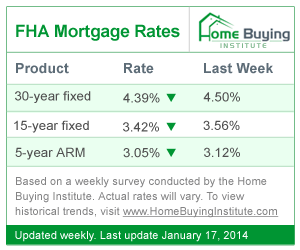
Here is the latest average FHA loan rate:
Current FHA Rates

12-4-2014: HUD AND TREASURY ANNOUNCE ENHANCEMENTS TO HOUSING PROGRAM – Under the revised guidelines announced today, all homeowners in HAMP will now be eligible to earn $5,000 in the sixth year of their modification, which will reduce their outstanding principal balance by as much as $10,000. Homeowners will also be offered an opportunity to re-amortize the reduced mortgage balance, which will have the effect of lowering their monthly payment. As of today, approximately one million homeowners with HAMP modifications are eligible to earn the increased HAMP incentive. Source: http://portal.hud.gov/hudportal/HUD?src=/press/press_releases_media_advisories/2014/HUDNo_14-150

12-4-2014:  Federal district court bars foreclosure sale of first lien HUD-insured mortgages.   Federal law supersedes state law to protect losses at HUD and US taxpayers. Source: www.mpamag.com/real-estate/federal-district-court-bars-foreclosure-sale-of-first-lien-hudinsured-mortgages-20468.aspx<

10-22-2013: FHA delays ban on dual agency (i.e., both buyer and seller represented by the same broker) that was to take effect 10-1-2013. Source: http://norman-spencer.com/news/specialty/hud-to-delay-dual-agency-ban-for-real-estate-agents-514931

10-10-2013: Between 1997 and 2007, HUD’s loose lending practices for “affordable housing” created a bubble to deflate 30-40% of home prices? Source: WSJ, Opinion 9-18-2013, page A17.

10-8-2013: FHA may borrow $1 Billion from the US Treasury (FHA doesn’t need to ask for (my words – their $16B) “direct” taxpayer bailout – yet – since it can tap the US Treasury for financial assistance). Source: WSJ, 9-26-2013, A6.

9-14-2013: FHA to cut waiting time after foreclosure/short sale to 12 months under certain criteria (that as of the date of this update hasn’t been disseminated to many lenders)…But will lenders comply as they try to resell these loans to investors…hold the loans to season them…or just not make them…?Stay tuned! Source: http://www.macon.com/2013/09/12/2659718/fha-cuts-waiting-time-for-foreclosed.html

3-13-2013: FHA will need a bailout, but depends on what President Obama asks for in his March 2013 budget…if he releases it.

12-25-2012: Since HUD is expected to be underwater by $16.3 Billion, can these changes be brewing?: HUD raising minimum FHA loan score from 580 to 620? Or eliminating the HECM Reverse Mortgage Program? It’s a possibility… Source: http://www.inman.com/buyers-sellers/columnists/kenharney/talk-big-changes-fha-may-be-just-now

Much more information can be obtained from this HUD website:
HUD Press Releases.

12-3-2012: FHA has extended its waiver throughout all of 2013 allowing investors to sell flipped properties within the currently prohibited 90 day period after they purchased and possibly renovated the property. FHA extends 90 day flipping waiver.

The FHA’s reserves are supposed to be depleted by sometime in 2013 if they don’t get an infusion from US Congress

Posted in Uncategorized | Comments Off on FHA/HUD News

Solar panels – yes or no in HOA subdivisions?

Solar Panels May Effect Your Home’s Value, In Either Direction.

Could this become an issue that the US Supreme Court could hear?

April 2012 article in the Atlanta Journal Constitution raised questions about a installation of solar panels v. HOA authority over their installation – what do U think?

According to Georgia laws, it appears if HOAs don’t make official changes in their HOA CCRs before 2013 prohibiting the installation of solar panels, then they can’t object other than to limit visibility of the panel to roofs or fenced in patios in back yard.

When you buy  home in a subdivision governed by an HOA, most HOA CCRs (Conditions, Covenants, and Restrictions of ownership) state if any changes are to be made to the exterior of the house or property, as visible from the street, the change must first be approved by the HOA Architectural Control Committee before work is performed.  Home buyer sign such an agreement at closing that they will comply with the HOA CCRs already passed and those in future that are passed.

Government offers a tax break, but will your HOA allow you to install them? Apparently, there may be a 30% Federal Income Tax deduction for installation costs (including panel costs).

Source:  Solar Power Standoff (AJC page B8, 4-29-2012)

Posted in Uncategorized | Comments Off on Solar panels – yes or no in HOA subdivisions?

What’s in store for real estate in 2013?

In order to answer where we are going, we need to understand where we’ve been and what is being done differently than before.

We’ve been reeling from the impact of artificially inflated home prices and MBS => Tranches => CDOs/derivatives (>$70 Trillion still exist and JP Morgan Chase has over $700 trillion in total derivative alone) which in short, are large insured gambles that failed with falling home prices and where at every level that touched real estate: financial firm/investors; real estate (agents, buyers, sellers, appraisers); US Congress; Gov’t regulators; GSEs (Fannie/Freddie), rating agencies (Fitch, Moody’s, S&P), mortgage industry (lenders, loan officers), and the Federal Gov’t (including FHA relaxation of their mortgage restrictions) with laws requiring certain non-common sense loans to be made who participated in the debacle.

Dodd-Frank law is a joke and doesn’t solve any of the major causes of this mess. In addition to not closing an economic loophole that created the derivatives market, the Federal Government is now trying to solve the problem they created – allowing huge exposure in financial markets! It intends to define a Qualified Residential Mortgage, but they still haven’t. They have combined 2 loan disclosure forms for borrowers, but the majority of borrowers didn’t need the simplified forms. The FHA is going to both increase and require annual MIP for all FHA loans in 2013 and beyond to become “permanent”. That means the annual MIP is never eliminated after the original LTV reaches 78% (per current Federal law).

So how does all this impact you?

Update 4-12-2013: What’s happening in 2013? Some ups and some downs…http://www.forbes.com/sites/morganbrennan/2013/04/12/where-u-s-real-estate-might-be-getting-bubbly/

Parker’s Projections for 2013

– You will hear that the housing prices have hit bottom and are going back up – Well, that all depends on where you look and since all real estate is local – it depends on prices and condition in your subdivision/immediate area. In my subdivision, similar homes but different physical conditions have sold for as low as $59K to as high as $189K. If you need me to run an analysis of value, let me know but it will depend on prices in your subdivision and within a mile radius.

– There are 11 million homeowners underwater (owing more than their house is worth) and it will take a while (another 2-4 years) to reverse that direction. If the economy gets worse next year, expect higher rates of foreclosure. Especially since the major class action Federal lawsuit against lenders for non Government loans was settled for $25 billion and impact of Obamacare will be clearer on the full time employees and business decisions to continue employment/operations.

– The Federal Reserve has committed to keep residential real estate interest rates low until 2014 (same year Ben Bernanke is leaving the Fed), so this tends to keep real estate purchases and refinance attractive. But artificially low rates mean much higher rates to come after that. Higher rates will have a downward pressure on home prices that may offset low inventory.

– The 2007 Mortgage Forgiveness Debt Act, if not extended, will mean those who get foreclosed or agree to short sales will pay income taxes (the loss is considered income by the IRS) on the difference between (what they wind up receiving for your property) less (their expenses plus your loan balance on the property). It also depends on whether the lender’s costs to sell the property are included in that loss and subsequent taxable income. That really stinks that you have to pay income taxes on a loss on a home you no longer own – and that tax liability NEVER disappears!

– There are now fewer than 16,000 residential single family properties for sale on the FMLS (statewide) database, down from 25,000 a year ago; 10,000 are now under contact but not closed; and about 21,000 listings expired this year but some of them were relisted. Add another 1,000 or so that are for sale by owner or not in FMLS statewide and that accounts for very few choices for Buyers. Low supply may push prices higher. But since many distressed properties were being sold for low prices, no Seller wants to compete against those properties and therefore don’t put their homes up for sale unless driven from necessity or pure desire to move. If Sellers believe the market is getting better, they’ll place more homes on market and increase supply which may drive prices down by having “too” many choices. The major complaint now is that there is not a “good & balanced” choice of inventory. However, it also doesn’t mean there is a rush to buy a home at a premium even though the supply is low, but the nicer homes in good areas get multiple offers. Buyers are still looking for pristine properties with updated kitchens and bathrooms or equivalent within subdivision; very open and uncluttered; and in the right school district.

So what can we really expect in 2013 in residential real estate?

Another bumpy up and down mixed bag ride!

– Continued low interest rates, low inventory of standard resale homes, more foreclosures/short sales than we saw in 2012, more downward pressure on home prices but pockets of rising prices, current rise in new housing construction to level off, mortgage interest deduction to be capped at a certain level, economic recessionary market after 1Q13, higher unemployment levels of full time employees, more employment of temporary part time employees, more start-up businesses, more retirees filing for early social security retirement, more Federal Reserve QE4 push to inflationary consumer prices and more opportunities to find micro markets for goods and services which will probably all retard economic growth and the movement and sale of existing residential real estate.

Posted in Uncategorized | Comments Off on What’s in store for real estate in 2013?

Smyrna Biodiesel – Cost v. Benefit -Too many questions

11-6-2014: Over 300 gallons of cooking oil was collected in 2013 to help power Smyrna vehicles.

Just diverting from real estate in this post, but I get a cold chill each time I see another example how local Governments use your tax money.

Ask yourself one question:
What do local Governments do better than private industry?

Answer: Spend more money than necessary!

Some examples come to mind:
City of Marietta’s Fibernet…
City of Marietta’s Marietta Conference Center…
Cobb County’s unsuccessful operation of a compost plant…
Cobb County’s future $400 million expenditure on a stadium…
Cobb County’s expansion of McCullum Airport to become an International Airport and the extra air traffic…
Extra toll lanes off Interstate I-75 and I-575…
Eventual future expansion and development of mass transit including bus and rail…

A December 9, 2012 article in the Marietta Daily Journal about the City of Smyrna starting a cooking oil recycling program to convert cooking oil into biodiesel fuel and I started asking myself questions.

Now, I’m all for Government recycling if it makes economic sense but why not leave it to something the private sector can do more efficiently.

First, the City of Smyrna received a Federal Grant of $208,000 under the $3.2 Billion Energy Efficiency and Conservation Block Grant Program.

– Helped start the program, so it must be included in the payback calculation – right?
– Does anyone think Government spending on this is necessary?
– Does anyone think that biodiesel will survive without Government support?
– Does anyone think receiving a US Federal Grant comes with “no” strings attached?

Second, has anyone reported the cost of establishing and maintaining cooking oil collection stations and cost of logistics retrieving the oil from collection stations?

Third, “once the system is at capacity”, Smyrna estimates an annual savings of $32,000.

– Says who and what data were used in these calculations?
– Do you think the logistics of residents transporting used oil to one of the drop off stations will be convenient or competitive with other restaurants that collect the cooking oil for other customers/vendors?

Fourth, Since the addition of ethanol to auto gasoline has caused significant operational issue with small engines, biodiesel fuel may also cause engine wear issues. Has anyone explored those long term maintenance or reduced useful life of engine or components? How about replacement of the F-450s and F550s sooner than expected since this fuel might burn at a different rate and cause more engine wear? Factors in the future change, what guarantee do we have in the future that the trucks used by water, sewer, and trash departments will still be used or will it be bid out to private industry? Future equipment and programs are very fluid and don’t assume it ill remain the same mix.

Fifth, the reason that some local Governments are looking into biodiesel fuel doesn’t mean its right for them or something they need to “invest” in. The City of Marietta has been purchasing biodiesel fuel from a local vendor, so why not leave it up to the private marketplace to supply it more efficiently than Government?

Sixth, the City of Smyrna estimates that once the facility is at maximum production, the city will reduce diesel fuel consumption by 27% at a $32,000 annual savings.

– Will diesel fuel prices increase, remain same, or decrease?
– What does maximum production mean?

Seventh, if Smyrna is the only local Government doing this, why? Do you think other Governments have studied this or eliminated the cost v. benefit? If the $208,000 taxpayer “donation” was required to start the program, is that a good use of taxpayer “donations”?

My spider sense says – NO!

Source: MDJ Smyrna Biodiesel Article

Posted in Uncategorized | Comments Off on Smyrna Biodiesel – Cost v. Benefit -Too many questions